Winter camping is an exercise in meticulous energy management and moisture control. Unlike summer backpacking, where mistakes usually result in mere discomfort, winter errors compound rapidly into serious hypothermic risks. Success in sub-zero environments hinges on a rigid adherence to systems regarding layering, hydration, and shelter.
The Paradox of Moisture Management
The primary antagonist in winter environments is not the cold air; it is moisture. Sweating is dangerous. Water conducts heat away from the body 25 times faster than air. If you sweat into your base layers during an arduous snowshoe ascent, that trapped moisture will freeze as soon as you stop moving, rapidly stripping your core temperature.
Active layering management is non-negotiable. Begin hikes feeling slightly cold ("be bold, start cold"). As your body generates heat, vent your jackets via pit-zips. If you begin to sweat, you must stop immediately and remove a layer. The goal is thermal equilibrium.
The Winter Layering Ecosystem
Base Layer: The foundation. Must be moisture-wicking. Merino wool or specialized synthetic fibers like Capilene. Cotton is strictly prohibited. The base layer should fit snugly to pull moisture directly off the skin.
Mid Layer: The primary insulator. Fleece, alpaca wool, or synthetic active insulation (e.g., Polartec Alpha) excels here because they breathe exceptionally well during heavy exertion, unlike down jackets which trap vapor.
Static Insulation Layer: A heavily lofted down or synthetic parka, colloquially known as the "belay parka." This jacket stays in the pack during movement and is deployed the precise second you stop to rest or build camp.
Outer Shell: A breathable waterproof membrane (e.g., Gore-Tex) or a highly breathable soft-shell designed to block wind and repel falling snow without trapping internal perspiration.
4-Season Shelter Engineering
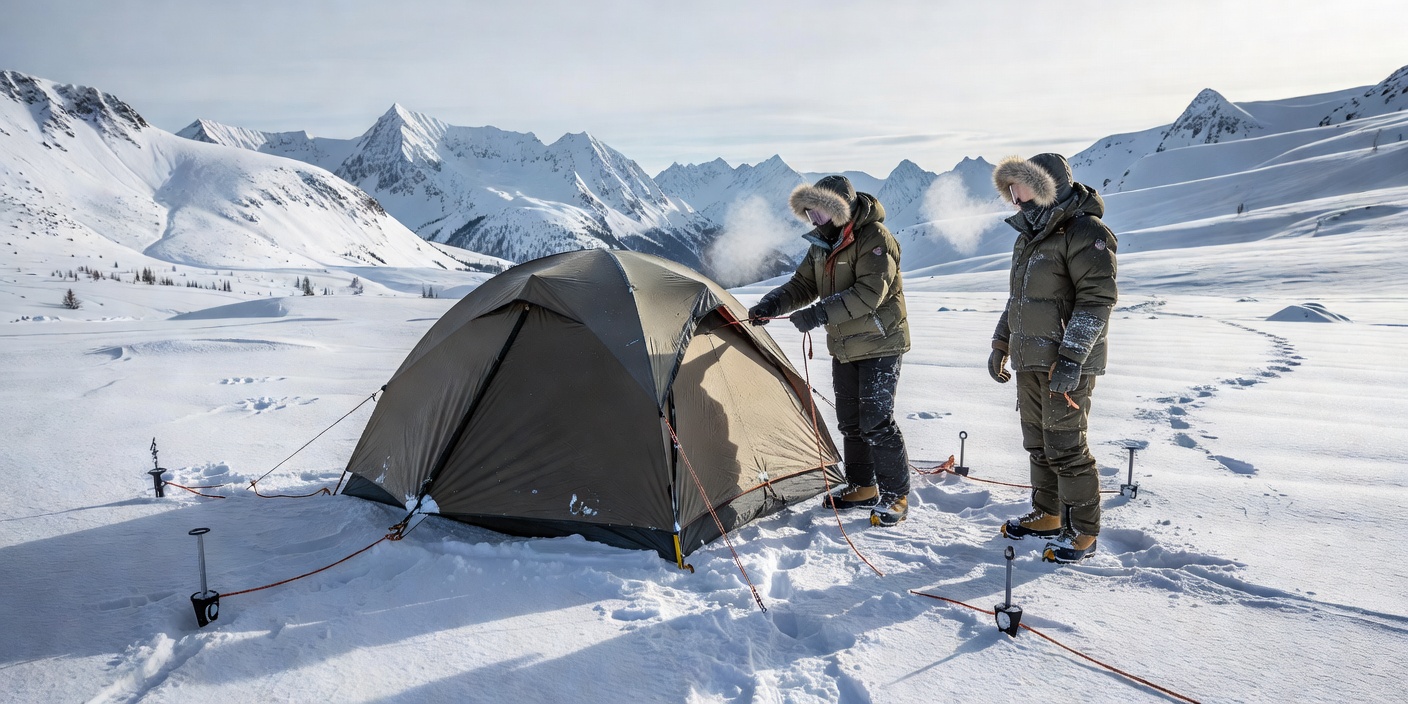
Tents designed for summer prioritize ventilation; tents designed for winter prioritize structural rigidity against snow loading and high winds. A true 4-season tent often utilizes rigid pole geometries (such as geodesic dome designs), robust fabrics, and solid inner walls rather than mesh, to prevent spindrift from blowing into the sleeping compartment.
Staking a tent in snow requires specialized deadman anchors—burying snow stakes, trekking poles, or stuffed stuff-sacks horizontally in the snowpack, allowing the snow to harden around them. Standard aluminum stakes are useless in deep powder.
Sub-Zero Hydration and Caloric Demand
Your body acts as an internal furnace. To keep the furnace burning in sub-zero conditions, you must constantly feed it fuel. Caloric requirements easily double in winter conditions. Fats—such as butter, olive oil, and nuts—are crucial because they offer the highest caloric density (9 calories per gram) and provide slow-burning, sustained heat throughout the night.
"In winter, the margin for error shrinks to the width of a zipper. Manage your heat before you lose it, because regaining it is infinitely harder."
Water management is equally challenging because hydration reservoirs will freeze solid. Use wide-mouth, hard-sided bottles. Store them upside down in your pack; because water freezes from the top down, storing them inverted ensures the threading and opening remain liquid longer. At night, fill a hard-sided bottle with boiling water, wrap it in a spare shirt, and place it at the foot of your sleeping bag to serve as a long-lasting radiant heat source.
Operating in winter environments demands a shift from casual enjoyment to disciplined execution. By rigorously managing your thermal output, fortifying your sleep system, and keeping internal fuel levels high, the frozen wilderness transforms from a hostile wasteland into a profoundly serene landscape.